Chloroplast
In brief
A chloroplast is a photosynthetic organelle of plants and algae. Its thylakoid membranes and surrounding stroma perform complementary tasks: light-driven electron transport helps produce ATP and NADPH, while carbon-fixation reactions use them to build organic compounds. Different compartments bring these reactions together in one organelle. [6] [7] [8] [9] [10]
Evidence for this statement
Source-based explanation
- Cooper (2000) · Chloroplasts and Other Plastids
- Alberts et al. (2002) · Chloroplasts and Photosynthesis
- Clark, Douglas & Choi · Biology 2e · 8.1 Overview of Photosynthesis
- Clark, Douglas & Choi · Biology 2e · 8.2 Light-Dependent Reactions
- Clark, Douglas & Choi · Biology 2e · 8.3 Carbon Fixation
Where to check this statement
- biology59-plastids
- Chloroplast envelope, stroma, thylakoid membrane and proton gradient paragraphs
- biology59-carbon
- Chloroplasts Capture Energy from Sunlight and Use It to Fix Carbon; carbon-fixation cycle paragraphs
- biology59-overview
- Basic Photosynthetic Structures: envelope, thylakoid membranes, grana, lumen and stroma
- biology59-light
- How Light-Dependent Reactions Work; Figure8.17 explanatory text: PSII/PSI, ATP, NADPH and proton gradient; no figure reused
- biology59-fixation
- The Calvin Cycle; Stages1–3: fixation, reduction and regeneration; no quantitative ATP/NADPH lifetime or evolutionary dating claim used
Save, investigate and check this version
Editorial draft · human review pending
Ask about this materialOn this page
Where light energy becomes chemical work
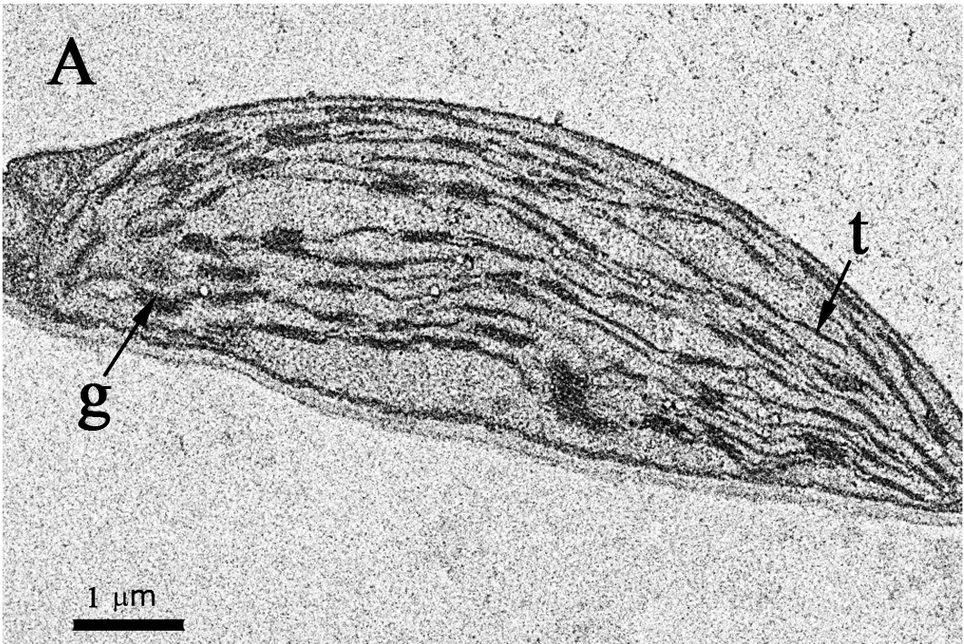
The electron micrograph shows a chloroplast from a control Arabidopsis seedling in a particular study. The original figure retains a 1 μm scale; it does not show a spruce chloroplast.
[1] [2] [3]Evidence for this statement
Source-based explanation
- GO:0009507 · chloroplast
- Arabidopsis thaliana, first leaf of control seedling grown without added NaCl; Figure 3A
- UniProt P83755 · entry 161 / sequence 2
Where to check this statement
- go-chloroplast
- Captured GO ontology JSON: results[].id and definition.text
- uniprot-P83755
- Captured UniProt JSON: primaryAccession, organism, sequence and FUNCTION comments
From organelle structure you can explore photosystem II and a PsbA protein record. This connects concepts; it does not establish that the molecular record came from the pictured specimen.
[1] [2] [3]Evidence for this statement
Source-based explanation
- GO:0009507 · chloroplast
- Arabidopsis thaliana, first leaf of control seedling grown without added NaCl; Figure 3A
- UniProt P83755 · entry 161 / sequence 2
Where to check this statement
- go-chloroplast
- Captured GO ontology JSON: results[].id and definition.text
- uniprot-P83755
- Captured UniProt JSON: primaryAccession, organism, sequence and FUNCTION comments
Structure and function
Evidence for this statement
EcoGenesis
Envelope
Outer and inner membranes
Thylakoid membrane
Light-driven electron transfer and ATP synthesis
Stroma
Carbon-fixation reactions
Envelope, stroma and thylakoids
The envelope has outer and inner membranes. Inside lies the stroma, with metabolic enzymes and the chloroplast genetic system. Thylakoid membranes form a separate internal system enclosing the lumen; stacks are called grana. The envelope and the thylakoid system are different membranes with different roles.
[6] [8] [9]Evidence for this statement
EcoGenesis
- Cooper (2000) · Chloroplasts and Other Plastids
- Clark, Douglas & Choi · Biology 2e · 8.1 Overview of Photosynthesis
- Clark, Douglas & Choi · Biology 2e · 8.2 Light-Dependent Reactions
Where to check this statement
- biology59-plastids
- Chloroplast envelope, stroma, thylakoid membrane and proton gradient paragraphs
- biology59-overview
- Basic Photosynthetic Structures: envelope, thylakoid membranes, grana, lumen and stroma
- biology59-light
- How Light-Dependent Reactions Work; Figure8.17 explanatory text: PSII/PSI, ATP, NADPH and proton gradient; no figure reused
How a membrane helps make ATP
Electron transport builds an electrochemical proton gradient across the thylakoid membrane. Protons returning through ATP synthase drive ATP production on the stromal side. ATP and NADPH support carbon fixation. Separating compartments enables the gradient to do chemical work.
[6] [7] [8] [9] [10]Evidence for this statement
EcoGenesis
- Cooper (2000) · Chloroplasts and Other Plastids
- Alberts et al. (2002) · Chloroplasts and Photosynthesis
- Clark, Douglas & Choi · Biology 2e · 8.1 Overview of Photosynthesis
- Clark, Douglas & Choi · Biology 2e · 8.2 Light-Dependent Reactions
- Clark, Douglas & Choi · Biology 2e · 8.3 Carbon Fixation
Where to check this statement
- biology59-plastids
- Chloroplast envelope, stroma, thylakoid membrane and proton gradient paragraphs
- biology59-carbon
- Chloroplasts Capture Energy from Sunlight and Use It to Fix Carbon; carbon-fixation cycle paragraphs
- biology59-overview
- Basic Photosynthetic Structures: envelope, thylakoid membranes, grana, lumen and stroma
- biology59-light
- How Light-Dependent Reactions Work; Figure8.17 explanatory text: PSII/PSI, ATP, NADPH and proton gradient; no figure reused
- biology59-fixation
- The Calvin Cycle; Stages1–3: fixation, reduction and regeneration; no quantitative ATP/NADPH lifetime or evolutionary dating claim used
Membranes and internal space
The Gene Ontology definition describes chloroplast organisation through thylakoids and stroma. Some thylakoids form grana; connecting regions are also named in the definition. This organisation helps interpret a micrograph but does not replace its scale or supply dimensions for every chloroplast.
[1]Evidence for this statement
Explanation of retained sources
Where to check this statement
- go-chloroplast
- Captured GO ontology JSON: results[].id and definition.text
Keeping the image caption
The illustrated material belongs to a control Arabidopsis seedling in a particular study. The 1 μm scale belongs to the original figure. Before comparing another image, check organism, material, conditions and scale: following a link does not turn an Arabidopsis chloroplast image into a spruce chloroplast image.
[2]Evidence for this statement
Explanation of retained sources
Structure, process and protein
Chloroplast is a cellular component, photosynthesis a biological process and photosystem II a molecular complex. These categories explain different aspects of a question. UniProt P83755 identifies another object: the Arabidopsis D1 protein. Conceptual links do not establish a shared specimen across these materials.
[1] [4] [5] [3]Evidence for this statement
Explanation of retained sources
- GO:0009507 · chloroplast
- GO:0015979 · photosynthesis
- GO:0009523 · photosystem II
- UniProt P83755 · entry 161 / sequence 2
Where to check this statement
- go-chloroplast
- Captured GO ontology JSON: results[].id and definition.text
- go-photosynthesis
- Captured GO ontology JSON: results[].id and definition.text
- go-photosystem2
- Captured GO ontology JSON: results[].id and definition.text
- uniprot-P83755
- Captured provider JSON; named selected record and native source versions
Connected concepts
Photosynthesis
Photosynthesis synthesises organic compounds, including carbohydrates, from carbon dioxide using light energy. Gene Ontology identifies it as the biological process GO:0015979.
[4] [5]Evidence for this statement
Source-based explanation
Where to check this statement
- go-photosynthesis
- Captured GO ontology JSON: results[].id and definition.text
- go-photosystem2
- Captured GO ontology JSON: results[].id and definition.text
Photosystem II
Photosystem II is a molecular complex associated with pigments and electron carriers. In chloroplasts and cyanobacteria it uses light to transfer electrons from water to plastoquinone.
[5] [3]Evidence for this statement
Source-based explanation
Where to check this statement
- go-photosystem2
- Captured GO ontology JSON: results[].id and definition.text
- uniprot-P83755
- Captured provider JSON; named selected record and native source versions
Continue with an organism
The photographs and molecular record come from separate source materials.
Your research question
Save the article to return to your question and this source version.
Plan a test
This is your research plan. Completing these fields does not confirm a hypothesis.
Sources and versions
Editorial draft · human review pending
- GO:0009507 · chloroplast
2026-09-09T01:17:34.931415+00:00 · CC-BY-4.0
Provenance and original
- Original SHA-256
- 13082607c7dcc9e92cd281f1fc6a8fdf2878bceba74e9d7b6ad50d43b0ce33ba
- Processing
- Unmodified provider response; article text is an attributed educational summary.
- Version details
- QuickGO response did not supply a native ontology release; retrieval time and exact response hash retained.
- Arabidopsis thaliana, first leaf of control seedling grown without added NaCl; Figure 3A
Retrieval date unknown · CC BY 4.0
Provenance and original
- Original SHA-256
- fe305c7d3a3327a06dda04c186989b5b8b6dec101bfe13aa851a3bc47dc07b14
- Processing
- Panel A extracted; original g/t annotations and 1 µm scale retained; encoded as WebP.
- UniProt P83755 · entry 161 / sequence 2
2026-09-09T01:17:34.554931+00:00 · CC-BY-4.0
Provenance and original
- Source version
- entry 161; sequence 2
- Original SHA-256
- f16a5f33fbf85a12aa5c91ab31f6092f0bbe3be874040c84c4954e87b20ae3a9
- Processing
- Unmodified provider response; article text is an attributed educational summary.
- Version details
- Provider entry/sequence versions retained.
- GO:0015979 · photosynthesis
2026-09-09T01:17:01.233038+00:00 · CC-BY-4.0
Provenance and original
- Original SHA-256
- 8649763135938e40bdb112c62e870749510eea1b750ff5d230a3061be5a3e017
- Processing
- Unmodified provider response; article text is an attributed educational summary.
- Version details
- QuickGO response did not supply a native ontology release; retrieval time and exact response hash retained.
- GO:0009523 · photosystem II
2026-09-09T01:17:35.068503+00:00 · CC-BY-4.0
Provenance and original
- Original SHA-256
- 56537702684f4e6949eb9b16430a8830740bc9fd3369b21e7b5a9b711a341b4f
- Processing
- Unmodified provider response; article text is an attributed educational summary.
- Version details
- QuickGO response did not supply a native ontology release; retrieval time and exact response hash retained.
- Cooper (2000) · Chloroplasts and Other Plastids
2026-10-01 · Terms of use on source site
Provenance and original
- Source version
- Selected web passages checked 2026-10-01; no immutable response edition asserted
- Source reading scope
- Named background passages only; not new experimental evidence.
- Location in the original source
- Chloroplast envelope, stroma, thylakoid membrane and proton gradient paragraphs
- Alberts et al. (2002) · Chloroplasts and Photosynthesis
2026-10-01 · Terms of use on source site
Provenance and original
- Source version
- Selected web passages checked 2026-10-01; no immutable response edition asserted
- Source reading scope
- Named background passages only; not new experimental evidence.
- Location in the original source
- Chloroplasts Capture Energy from Sunlight and Use It to Fix Carbon; carbon-fixation cycle paragraphs
- Clark, Douglas & Choi · Biology 2e · 8.1 Overview of Photosynthesis
2026-10-01 · Terms of use on source site
Provenance and original
- Source version
- Selected publisher HTML passages checked 2026-10-01
- Source reading scope
- Named foundational biology paragraphs only; background facts checked against classical textbooks and captured GO/UniProt records; not an experimental result.
- Location in the original source
- Basic Photosynthetic Structures: envelope, thylakoid membranes, grana, lumen and stroma
- Clark, Douglas & Choi · Biology 2e · 8.2 Light-Dependent Reactions
2026-10-01 · Terms of use on source site
Provenance and original
- Source version
- Selected publisher HTML passages checked 2026-10-01
- Source reading scope
- Named foundational biology paragraphs only; background facts checked against classical textbooks and captured GO/UniProt records; not an experimental result.
- Location in the original source
- How Light-Dependent Reactions Work; Figure8.17 explanatory text: PSII/PSI, ATP, NADPH and proton gradient; no figure reused
- Clark, Douglas & Choi · Biology 2e · 8.3 Carbon Fixation
2026-10-01 · Terms of use on source site
Provenance and original
- Source version
- Selected publisher HTML passages checked 2026-10-01
- Source reading scope
- Named foundational biology paragraphs only; background facts checked against classical textbooks and captured GO/UniProt records; not an experimental result.
- Location in the original source
- The Calvin Cycle; Stages1–3: fixation, reduction and regeneration; no quantitative ATP/NADPH lifetime or evolutionary dating claim used
Inspect structured data
- Content version
- 05e63a6f913c0ae6f9666641cb3ac98455b4b0bf24409c2d92db9819955a2e0a
- Source version
- knowledge-20260909.1
- Updated
- 2026-10-01