Accepted name and authorship; native and introduced distribution; accepted infraspecifics; classification; source and licence fields. Entire relevant record text read. WCVP/IPNI 2026 attribution, not a downloaded versioned backbone.
evidence:S02
Citation; Taxonomy; General Distribution; Site Characteristics; Botanical Description; Seasonal Development; Regeneration Processes; beginning of Successional Status. Written February 1994; historical taxonomy not treated as current.
Accepted name and authorship; native and introduced distribution; accepted infraspecifics; classification; source and licence fields. Entire relevant record text read. WCVP/IPNI 2026 attribution, not a downloaded versioned backbone.
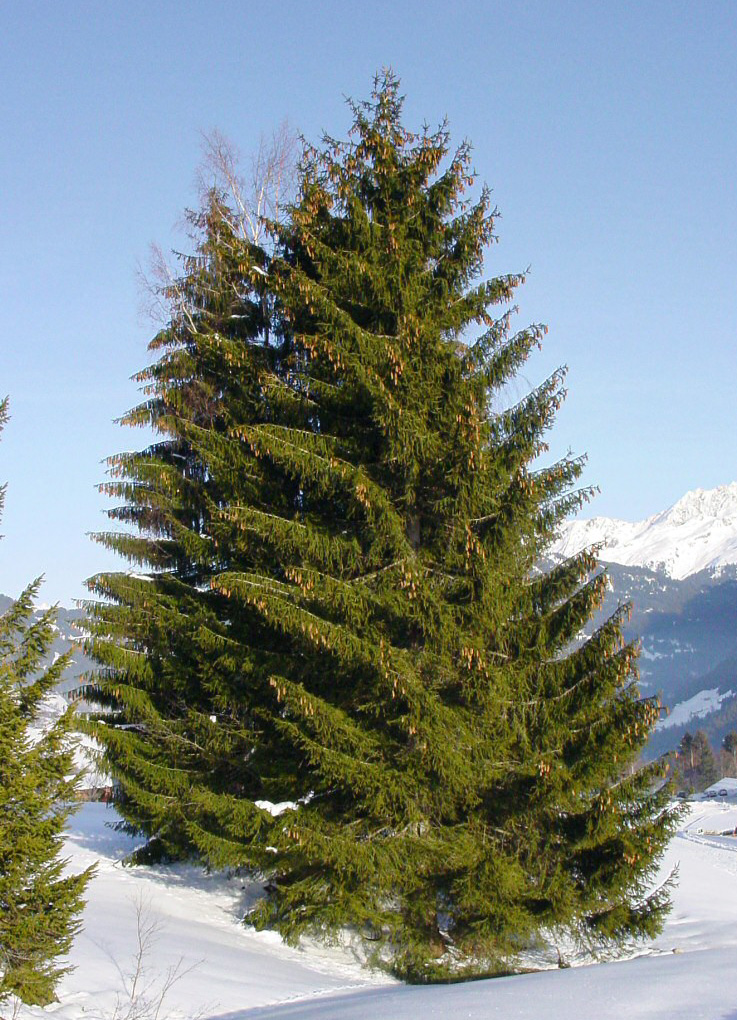
It is a major forest tree in northern Europe and in European mountain regions, rather than a species confined to Norway.
All three PDF pages, numbered 114–116: text, map legends, captions and references visually inspected in web screenshots; qualitative map scope checked, no underlying occurrence data read. Habitat and Ecology; Importance and Usage; Threats and Diseases.
Recognizing the tree
A straight trunk, a conical to columnar crown and drooping secondary branchlets give mature Norway spruce its characteristic outline.
Citation; Taxonomy; General Distribution; Site Characteristics; Botanical Description; Seasonal Development; Regeneration Processes; beginning of Successional Status. Written February 1994; historical taxonomy not treated as current.
The rigid needles are four-angled in cross-section and about 1–2.5 cm long.
All three PDF pages, numbered 114–116: text, map legends, captions and references visually inspected in web screenshots; qualitative map scope checked, no underlying occurrence data read. Habitat and Ecology; Importance and Usage; Threats and Diseases.
Young seed cones stand upright before pollination, then become pendant; by autumn they turn from green to brown.
All three PDF pages, numbered 114–116: text, map legends, captions and references visually inspected in web screenshots; qualitative map scope checked, no underlying occurrence data read. Habitat and Ecology; Importance and Usage; Threats and Diseases.
The long, cylindrical cones open as they dry and release winged seeds.
All three PDF pages, numbered 114–116: text, map legends, captions and references visually inspected in web screenshots; qualitative map scope checked, no underlying occurrence data read. Habitat and Ecology; Importance and Usage; Threats and Diseases.
From pollen to seedlings
Norway spruce bears separate pollen-producing and seed-bearing structures on the same tree, a condition called monoecy.
All three PDF pages, numbered 114–116: text, map legends, captions and references visually inspected in web screenshots; qualitative map scope checked, no underlying occurrence data read. Habitat and Ecology; Importance and Usage; Threats and Diseases.
Wind carries conifer pollen between trees, while the winged seeds provide a later, separate opportunity for dispersal.
Abstract; Main; Sequencing and assembly; Presence of long introns and gene-like fragments; selected figure-caption text. P.abies 1.0 historical study and sample Z4006 identified; not a current assembly endpoint verification.
evidence:S02
Citation; Taxonomy; General Distribution; Site Characteristics; Botanical Description; Seasonal Development; Regeneration Processes; beginning of Successional Status. Written February 1994; historical taxonomy not treated as current.
Seeds ripen in the year of pollination and may be released from late autumn into winter or retained until spring.
Citation; Taxonomy; General Distribution; Site Characteristics; Botanical Description; Seasonal Development; Regeneration Processes; beginning of Successional Status. Written February 1994; historical taxonomy not treated as current.
Seed production varies with age and growing conditions; large crops are not necessarily annual.
Citation; Taxonomy; General Distribution; Site Characteristics; Botanical Description; Seasonal Development; Regeneration Processes; beginning of Successional Status. Written February 1994; historical taxonomy not treated as current.
Young seedlings are vulnerable to drought and overheating, so germination alone does not guarantee establishment.
Citation; Taxonomy; General Distribution; Site Characteristics; Botanical Description; Seasonal Development; Regeneration Processes; beginning of Successional Status. Written February 1994; historical taxonomy not treated as current.
In moist settings the tree can also reproduce by layering, when a low branch roots while still connected to its parent.
Citation; Taxonomy; General Distribution; Site Characteristics; Botanical Description; Seasonal Development; Regeneration Processes; beginning of Successional Status. Written February 1994; historical taxonomy not treated as current.
A forest tree with partners below ground
Norway spruce tolerates shade and grows well in cool, moist conditions, although persistent waterlogging can inhibit growth.
Citation; Taxonomy; General Distribution; Site Characteristics; Botanical Description; Seasonal Development; Regeneration Processes; beginning of Successional Status. Written February 1994; historical taxonomy not treated as current.
Its root system is often shallow, contributing to vulnerability to drought and windthrow.
All three PDF pages, numbered 114–116: text, map legends, captions and references visually inspected in web screenshots; qualitative map scope checked, no underlying occurrence data read. Habitat and Ecology; Importance and Usage; Threats and Diseases.
The roots associate with ectomycorrhizal fungi, whose enzymes help mobilize nutrients from soil organic matter.
Summary; Introduction; Methods plant material and fungal strains; Results prose on growth response around Figure 2. Tables and figure images not analysed; claims confined to qualitative experimental outcomes.
Experiments with Norway spruce seedlings found that a more diverse fungal community could broaden the range of nutrient-mobilizing enzymes, while growth responses depended on the seedlings and fungal partners involved.
Summary; Introduction; Methods plant material and fungal strains; Results prose on growth response around Figure 2. Tables and figure images not analysed; claims confined to qualitative experimental outcomes.
Drought, resin and bark beetles
Resin is part of the tree’s defence: its chemical and physical properties can inhibit or trap attacking bark beetles.
Summary; Introduction through study rationale; Results Q5–Q6 on induced terpenes, phenolics and carbohydrates. Selected table text was displayed but numerical tables were not used or audited.
The Eurasian spruce bark beetle, Ips typographus, also carries fungal associates that interact with the tree’s living bark and wood.
Summary; Introduction through study rationale; Results Q5–Q6 on induced terpenes, phenolics and carbohydrates. Selected table text was displayed but numerical tables were not used or audited.
In a two-year rainfall-exclusion experiment, drought-stressed mature spruces experienced more beetle attacks and longer fungal lesions than controls.
Summary; Introduction through study rationale; Results Q5–Q6 on induced terpenes, phenolics and carbohydrates. Selected table text was displayed but numerical tables were not used or audited.
Their terpene defences did not simply disappear, showing that susceptibility cannot be reduced to a single “drought switches off resin” explanation.
Summary; Introduction through study rationale; Results Q5–Q6 on induced terpenes, phenolics and carbohydrates. Selected table text was displayed but numerical tables were not used or audited.
Why Norway spruce matters
Norway spruce supplies timber and pulpwood, and selected wood is used in soundboards and other musical-instrument components.
All three PDF pages, numbered 114–116: text, map legends, captions and references visually inspected in web screenshots; qualitative map scope checked, no underlying occurrence data read. Habitat and Ecology; Importance and Usage; Threats and Diseases.
It has also become an important subject for understanding large conifer genomes.
Abstract; Main; Sequencing and assembly; Presence of long introns and gene-like fragments; selected figure-caption text. P.abies 1.0 historical study and sample Z4006 identified; not a current assembly endpoint verification.
A 2013 genome study linked much of its enormous DNA content to the accumulation of repetitive mobile-element sequences, rather than a proportionately enormous number of protein-coding genes.
Abstract; Main; Sequencing and assembly; Presence of long introns and gene-like fragments; selected figure-caption text. P.abies 1.0 historical study and sample Z4006 identified; not a current assembly endpoint verification.
Keep geographic and taxonomic scales separate
Kew accepts Picea abies (L.) H.Karst. and distinguishes its European native distribution from introductions into other regions.
Accepted name and authorship; native and introduced distribution; accepted infraspecifics; classification; source and licence fields. Entire relevant record text read. WCVP/IPNI 2026 attribution, not a downloaded versioned backbone.
Its classification uses Streptophyta and Equisetopsida above Pinidae and Pinales, illustrating why an explicit source hierarchy matters when comparing taxonomic backbones.
Accepted name and authorship; native and introduced distribution; accepted infraspecifics; classification; source and licence fields. Entire relevant record text read. WCVP/IPNI 2026 attribution, not a downloaded versioned backbone.
What the 2013 genome actually represented
Nystedt and colleagues sequenced material from the Norway spruce clone Z4006 and estimated a nuclear genome size of 19.6 Gb.
Abstract; Main; Sequencing and assembly; Presence of long introns and gene-like fragments; selected figure-caption text. P.abies 1.0 historical study and sample Z4006 identified; not a current assembly endpoint verification.
Their P.abies 1.0 draft contained 4.3 Gb in scaffolds longer than 10 kb; that figure is a length-qualified assembly statistic, not a complete 19.6-Gb chromosome assembly.
Abstract; Main; Sequencing and assembly; Presence of long introns and gene-like fragments; selected figure-caption text. P.abies 1.0 historical study and sample Z4006 identified; not a current assembly endpoint verification.
They also described a separate chloroplast genome and a draft mitochondrial genome, which should not be merged with nuclear assembly totals.
Abstract; Main; Sequencing and assembly; Presence of long introns and gene-like fragments; selected figure-caption text. P.abies 1.0 historical study and sample Z4006 identified; not a current assembly endpoint verification.
Mechanisms need their experimental context
The drought experiment combined rainfall exclusion, beetle bioassays and fungal inoculation, rather than measuring the outcome of an uncontrolled regional mass outbreak.
Summary; Introduction through study rationale; Results Q5–Q6 on induced terpenes, phenolics and carbohydrates. Selected table text was displayed but numerical tables were not used or audited.
Its results separate resin flow, chemical concentrations and fungal damage; these are related but non-identical measures of defence.
Summary; Introduction through study rationale; Results Q5–Q6 on induced terpenes, phenolics and carbohydrates. Selected table text was displayed but numerical tables were not used or audited.
Likewise, seedling mycorrhizal experiments show context-dependent responses, not a guarantee that adding any fungal inoculant improves every spruce.
Summary; Introduction; Methods plant material and fungal strains; Results prose on growth response around Figure 2. Tables and figure images not analysed; claims confined to qualitative experimental outcomes.
sections[id=classification].claims[label=Source lineage] and [label=Source classification release]; full list and release object read
This is the source’s classification, not an inferred species phylogeny.
From this article to your own question
Choose a statement in this article and open its evidence. Record whether it concerns the whole species, a particular specimen or specific study conditions. Then follow a suitable guide to preserve identifiers and state which evidence your question still needs.
Accepted name and authorship; native and introduced distribution; accepted infraspecifics; classification; source and licence fields. Entire relevant record text read. WCVP/IPNI 2026 attribution, not a downloaded versioned backbone.
Citation; Taxonomy; General Distribution; Site Characteristics; Botanical Description; Seasonal Development; Regeneration Processes; beginning of Successional Status. Written February 1994; historical taxonomy not treated as current.
All three PDF pages, numbered 114–116: text, map legends, captions and references visually inspected in web screenshots; qualitative map scope checked, no underlying occurrence data read. Habitat and Ecology; Importance and Usage; Threats and Diseases.
Abstract; Main; Sequencing and assembly; Presence of long introns and gene-like fragments; selected figure-caption text. P.abies 1.0 historical study and sample Z4006 identified; not a current assembly endpoint verification.
Summary; Introduction; Methods plant material and fungal strains; Results prose on growth response around Figure 2. Tables and figure images not analysed; claims confined to qualitative experimental outcomes.
Summary; Introduction through study rationale; Results Q5–Q6 on induced terpenes, phenolics and carbohydrates. Selected table text was displayed but numerical tables were not used or audited.


 Sign in