This level reflects material verified for this passport. L3 requires a separate dossier with traceable claims, gaps and validation results. Such a dossier has yet to be confirmed for this record. Other sources may still be unchecked. What has been checked
Citation; Introduction; Distribution; selected Environmental Associations on soil and water; Sexual Reproduction including buds, pollination, fertilization, cone development, seed production/dispersal and germination; beginning of regeneration under established stands.
Citation; Introduction; Distribution; selected Environmental Associations on soil and water; Sexual Reproduction including buds, pollination, fertilization, cone development, seed production/dispersal and germination; beginning of regeneration under established stands.
The name Picea laxa also appears in modern botanical references: Kew’s Plants of the World Online accepts that name and treats Picea glauca as its synonym.
Entire visible name record: authorship, synonym-of link to Picea laxa, cited authorities, alternative taxonomies and WCVP/IPNI 2026 source attribution.
evidence:G02
Accepted name; native and introduced ranges; homotypic/heterotypic synonym lists including Picea glauca; classification and taxonomic authorities. No occurrence dataset or image read.
Shape, needles and cones
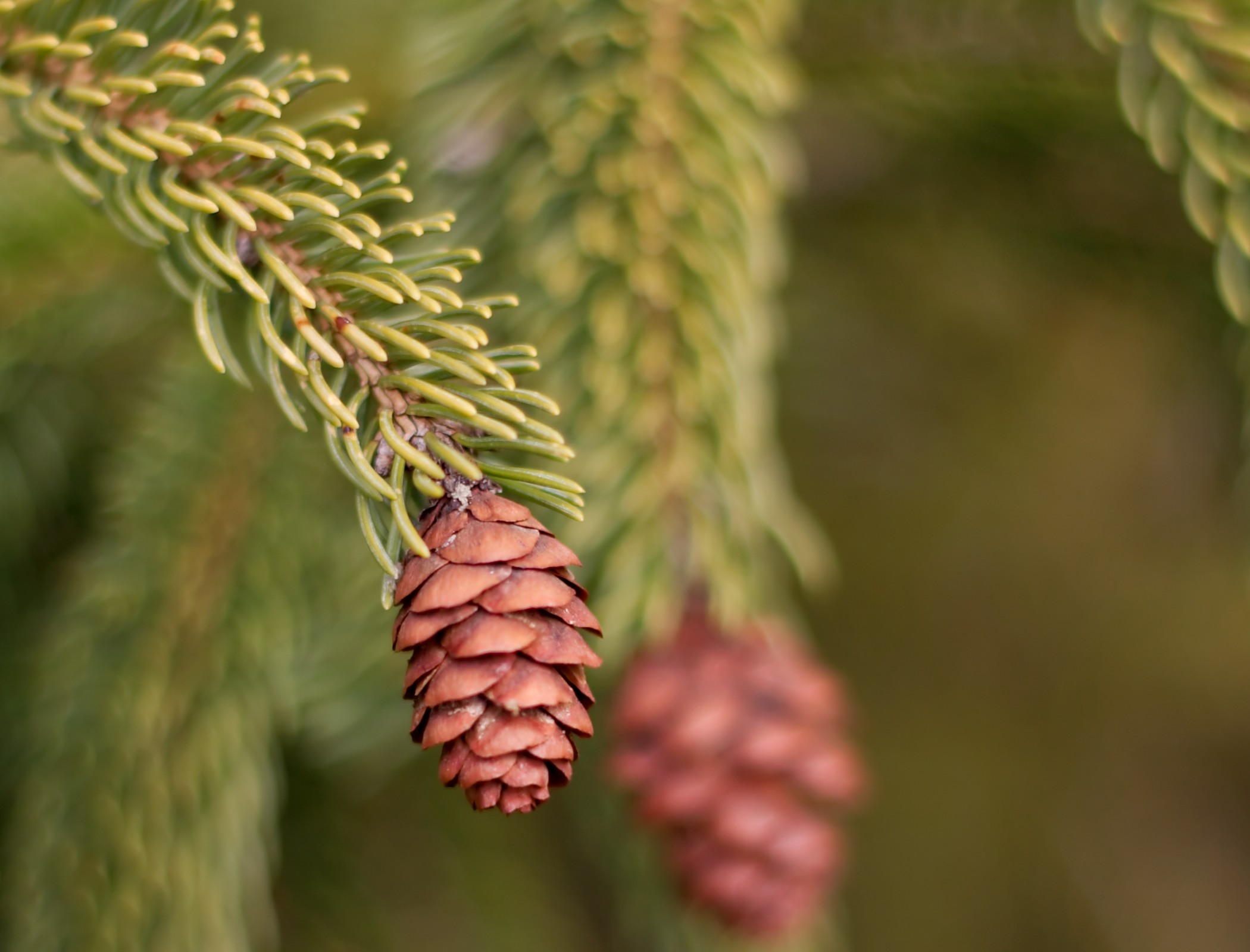
White spruce usually has a straight trunk, a conical or narrow crown and short, resinous needles.
Citation and Summary; Botanical Description/Morphology/Stand Structure; Fire Effects on Plants; Postfire Regeneration Strategy; Fire Adaptations; opening Plant Response to Fire; Importance to Wildlife and Livestock. Selected sections only of a long review.
Its hanging seed cones are commonly about 3–6 cm long, with small winged seeds inside.
Citation and Summary; Botanical Description/Morphology/Stand Structure; Fire Effects on Plants; Postfire Regeneration Strategy; Fire Adaptations; opening Plant Response to Fire; Importance to Wildlife and Livestock. Selected sections only of a long review.
The tree’s form changes with its setting: near treeline it can grow as a low, spreading shrub rather than a tall forest tree.
Citation and Summary; Botanical Description/Morphology/Stand Structure; Fire Effects on Plants; Postfire Regeneration Strategy; Fire Adaptations; opening Plant Response to Fire; Importance to Wildlife and Livestock. Selected sections only of a long review.
A season of reproduction
Pollen-producing and seed-bearing cones occur on the same tree, but generally occupy different parts of the crown.
Citation; Introduction; Distribution; selected Environmental Associations on soil and water; Sexual Reproduction including buds, pollination, fertilization, cone development, seed production/dispersal and germination; beginning of regeneration under established stands.
Reproductive buds begin developing in the year before pollination.
Citation; Introduction; Distribution; selected Environmental Associations on soil and water; Sexual Reproduction including buds, pollination, fertilization, cone development, seed production/dispersal and germination; beginning of regeneration under established stands.
Pollination timing varies with climate and elevation, and fertilization follows several weeks later.
Citation; Introduction; Distribution; selected Environmental Associations on soil and water; Sexual Reproduction including buds, pollination, fertilization, cone development, seed production/dispersal and germination; beginning of regeneration under established stands.
Developing seed cones turn downward, and the seeds mature later in the same growing season.
Citation; Introduction; Distribution; selected Environmental Associations on soil and water; Sexual Reproduction including buds, pollination, fertilization, cone development, seed production/dispersal and germination; beginning of regeneration under established stands.
Dry weather opens cones for seed release; wind then carries the seeds away.
Citation; Introduction; Distribution; selected Environmental Associations on soil and water; Sexual Reproduction including buds, pollination, fertilization, cone development, seed production/dispersal and germination; beginning of regeneration under established stands.
Cone crops vary greatly between years, so a mature tree does not provide the same seed supply every season.
Citation; Introduction; Distribution; selected Environmental Associations on soil and water; Sexual Reproduction including buds, pollination, fertilization, cone development, seed production/dispersal and germination; beginning of regeneration under established stands.
Where seedlings succeed
White spruce occupies river margins, uplands and treeline habitats, often alongside trees such as aspen, birch and black spruce.
Citation and Summary; Botanical Description/Morphology/Stand Structure; Fire Effects on Plants; Postfire Regeneration Strategy; Fire Adaptations; opening Plant Response to Fire; Importance to Wildlife and Livestock. Selected sections only of a long review.
It grows well with a reliable supply of aerated water but tolerates a range of soil conditions; stagnant water can restrict its roots.
Citation; Introduction; Distribution; selected Environmental Associations on soil and water; Sexual Reproduction including buds, pollination, fertilization, cone development, seed production/dispersal and germination; beginning of regeneration under established stands.
Seedlings may establish on decaying logs, while thick surface organic layers can impede regeneration in some forests.
Citation; Introduction; Distribution; selected Environmental Associations on soil and water; Sexual Reproduction including buds, pollination, fertilization, cone development, seed production/dispersal and germination; beginning of regeneration under established stands.
Living in a landscape that burns
White spruce is often killed by fire because of its thin bark and shallow roots.
Citation and Summary; Botanical Description/Morphology/Stand Structure; Fire Effects on Plants; Postfire Regeneration Strategy; Fire Adaptations; opening Plant Response to Fire; Importance to Wildlife and Livestock. Selected sections only of a long review.
Its cones are not normally held shut until fire releases the seed crop.
Citation and Summary; Botanical Description/Morphology/Stand Structure; Fire Effects on Plants; Postfire Regeneration Strategy; Fire Adaptations; opening Plant Response to Fire; Importance to Wildlife and Livestock. Selected sections only of a long review.
After a burn, regeneration commonly depends on seeds arriving from surviving trees at the edge or in unburned patches.
Citation and Summary; Botanical Description/Morphology/Stand Structure; Fire Effects on Plants; Postfire Regeneration Strategy; Fire Adaptations; opening Plant Response to Fire; Importance to Wildlife and Livestock. Selected sections only of a long review.
Insects and chemical defences
The eastern spruce budworm, Choristoneura fumiferana, feeds particularly on new foliage and can cause severe damage in spruce–fir forests.
Abstract; Background; Methods opening and Plant materials. Includes 211 unrelated mature trees, sampled defence traits and study design; no SNP-level causal validation claimed.
White spruce foliage contains defensive phenolic compounds, including the acetophenones piceol and pungenol.
Abstract; Background; Methods opening and Plant materials. Includes 211 unrelated mature trees, sampled defence traits and study design; no SNP-level causal validation claimed.
Trees differ in these chemical traits, and an association study in mature white spruce linked some of that variation to genetic markers.
Abstract; Background; Methods opening and Plant materials. Includes 211 unrelated mature trees, sampled defence traits and study design; no SNP-level causal validation claimed.
Such variation makes resistance a biological trait to investigate, not a guarantee that every white spruce resists an outbreak.
Abstract; Background; Methods opening and Plant materials. Includes 211 unrelated mature trees, sampled defence traits and study design; no SNP-level causal validation claimed.
Why the species matters
White spruce wood is used for pulp and construction lumber.
Citation; Introduction; Distribution; selected Environmental Associations on soil and water; Sexual Reproduction including buds, pollination, fertilization, cone development, seed production/dispersal and germination; beginning of regeneration under established stands.
It has also helped researchers tackle the challenge of assembling very large, repetitive conifer genomes.
Abstract; Introduction; Methods 2.1 Sample collection and opening 2.2. Primary paper read beyond abstract at publisher minimal HTML endpoint. Study accession string not independently endpoint-verified and not copied as a current accession.
Genome research has revealed duplicated genes and possible pseudogenes in defence-related families, opening questions about how chemical diversity evolves.
Summary; Introduction and opening assembly descriptions including PG29/WS77111 provenance and PG29 admixture; selected defence-gene interpretation paragraphs. Explicitly historical 2015 assemblies, not latest live NCBI versions.
Names do not erase provenance
Kew lists Picea glauca as a heterotypic synonym of Picea laxa, while its record also documents literature that accepted Picea glauca under an alternative treatment.
Entire visible name record: authorship, synonym-of link to Picea laxa, cited authorities, alternative taxonomies and WCVP/IPNI 2026 source attribution.
evidence:G02
Accepted name; native and introduced ranges; homotypic/heterotypic synonym lists including Picea glauca; classification and taxonomic authorities. No occurrence dataset or image read.
This is a source-specific taxonomic treatment, not evidence that a study conducted under the name Picea glauca concerned Norway spruce.
Entire visible name record: authorship, synonym-of link to Picea laxa, cited authorities, alternative taxonomies and WCVP/IPNI 2026 source attribution.
evidence:G04
Citation; Introduction; Distribution; selected Environmental Associations on soil and water; Sexual Reproduction including buds, pollination, fertilization, cone development, seed production/dispersal and germination; beginning of regeneration under established stands.
A genome belongs to sampled material
The 2013 shotgun-genome paper used apical shoots from genotype PG29 and reported a highly fragmented draft assembly.
Abstract; Introduction; Methods 2.1 Sample collection and opening 2.2. Primary paper read beyond abstract at publisher minimal HTML endpoint. Study accession string not independently endpoint-verified and not copied as a current accession.
Warren and colleagues later reported features of genetic admixture in PG29 involving white, Engelmann and Sitka spruces, alongside an assembly from the eastern genotype WS77111.
Summary; Introduction and opening assembly descriptions including PG29/WS77111 provenance and PG29 admixture; selected defence-gene interpretation paragraphs. Explicitly historical 2015 assemblies, not latest live NCBI versions.
Consequently, PG29 should not be treated as an unqualified genetically pure representative of all white spruce populations.
Summary; Introduction and opening assembly descriptions including PG29/WS77111 provenance and PG29 admixture; selected defence-gene interpretation paragraphs. Explicitly historical 2015 assemblies, not latest live NCBI versions.
The 2015 paper’s V3 and V4 labels describe historical PG29 assembly updates, not a claim about the newest available genome release.
Summary; Introduction and opening assembly descriptions including PG29/WS77111 provenance and PG29 admixture; selected defence-gene interpretation paragraphs. Explicitly historical 2015 assemblies, not latest live NCBI versions.
Association is not a complete defence mechanism
The acetophenone study sampled 211 unrelated mature trees and analysed chemical traits, Pgβglu-1 expression and genetic markers.
Abstract; Background; Methods opening and Plant materials. Includes 211 unrelated mature trees, sampled defence traits and study design; no SNP-level causal validation claimed.
Piceol and pungenol are distinguished from their sugar-linked counterparts, picein and pungenin, whose biological effects are not interchangeable.
Abstract; Background; Methods opening and Plant materials. Includes 211 unrelated mature trees, sampled defence traits and study design; no SNP-level causal validation claimed.
Marker associations can guide investigation, but they do not by themselves validate a causal effect for every associated gene.
Abstract; Background; Methods opening and Plant materials. Includes 211 unrelated mature trees, sampled defence traits and study design; no SNP-level causal validation claimed.
Entire visible name record: authorship, synonym-of link to Picea laxa, cited authorities, alternative taxonomies and WCVP/IPNI 2026 source attribution.
evidence:G02
Accepted name; native and introduced ranges; homotypic/heterotypic synonym lists including Picea glauca; classification and taxonomic authorities. No occurrence dataset or image read.
This is the source’s classification, not an inferred species phylogeny.
From this article to your own question
Choose a statement in this article and open its evidence. Record whether it concerns the whole species, a particular specimen or specific study conditions. Then follow a suitable guide to preserve identifiers and state which evidence your question still needs.
Citation; Introduction; Distribution; selected Environmental Associations on soil and water; Sexual Reproduction including buds, pollination, fertilization, cone development, seed production/dispersal and germination; beginning of regeneration under established stands.
Entire visible name record: authorship, synonym-of link to Picea laxa, cited authorities, alternative taxonomies and WCVP/IPNI 2026 source attribution.
Accepted name; native and introduced ranges; homotypic/heterotypic synonym lists including Picea glauca; classification and taxonomic authorities. No occurrence dataset or image read.
Citation and Summary; Botanical Description/Morphology/Stand Structure; Fire Effects on Plants; Postfire Regeneration Strategy; Fire Adaptations; opening Plant Response to Fire; Importance to Wildlife and Livestock. Selected sections only of a long review.
Abstract; Background; Methods opening and Plant materials. Includes 211 unrelated mature trees, sampled defence traits and study design; no SNP-level causal validation claimed.
Abstract; Introduction; Methods 2.1 Sample collection and opening 2.2. Primary paper read beyond abstract at publisher minimal HTML endpoint. Study accession string not independently endpoint-verified and not copied as a current accession.
Summary; Introduction and opening assembly descriptions including PG29/WS77111 provenance and PG29 admixture; selected defence-gene interpretation paragraphs. Explicitly historical 2015 assemblies, not latest live NCBI versions.


 Sign in